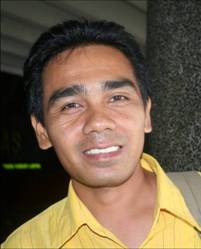
Some of Indonesia's Elite will go for candidate of Indonesian’s President, although all depend on legislative’ election . Golkar Party is one of Indonesia's party which become big sources of the candidate, they are Jussuf Kalla, Sri Sultan Hamengkubuwono X and Fadel Muhammad. Indonesian’s Press say some of the candidate are Susilo Bambang Yudhoyono, Sutiyoso, Megawati, M. Fadjroel Rachman, Wiranto, and Prabowo. As media covering they are still configuration of New Order. Except Megawati and the a pioneer independent Fadjroel Rachman, no one of them who a new face.
Beside that the founder of Indoensian reform and Partai Amanat National(PAN), Amin Rais said the chance of all is the same(R-from some sources)
PETROL REDUCING
SAMRY-Persatuan Pembangunan Party(PPP) propose to Indonesian’s government to reduce the petrol price amount Rp 1000 from its retail as be done by international market. This proposal certainly as likewise is willing of all Indonesian people as write of some mass media. Beside that, Indonesian economic expert, Faisal Basri(Harian Kompas, 3/11/2008), identify that is very difficult for Indonesia’s Government to do it above instability of international economic growth. This is different from Malaysia policy that reduced his petrol above the global petrol reducing(R-from some sources).
HOW HE DID IT 2008
The Age of Obama
Obama will need the spirits of Kennedy, FDR and Lincoln, and also a patient public.
By Jon Meacham NEWSWEEK
Published Nov 5, 2008
From the magazine issue dated Nov 17, 2008
The first time Barack Obama saw the White House was a quarter century ago, in 1984, when he was working as a community organizer based at the Harlem campus of the City College of New York. President Reagan was proposing reductions in student aid. The young Obama, just out of Columbia, got together with student leaders—"most of them black, Puerto Rican, or of Eastern European descent, almost all of them the first in their families to attend college"—to take petitions protesting the cuts to the New York delegation on Capitol Hill. Afterward, Obama wrote in "The Audacity of Hope," the group wandered down Pennsylvania Avenue to the Washington Monument and then to the White House, where they stood outside the gates, looking in.
The glib literary move at this point would be to note how Obama, who will become the 44th president of the United States on Jan. 20, 2009, will now return to that house to undo the work that was unfolding inside all those years ago—the work of the Republican Party of Nixon, Reagan and George W. Bush. But the story, like Obama himself, is more complicated than one might think. The Democratic Party's success in 2008 is not a straightforward revenge-of-the-left drama. Many true believers say this is the dawn of a new progressive era, a time of resurgent (and in many ways rethought) liberalism. The highly caffeinated have high hopes. At the same time, many conservatives—most, it seems, with a show on Fox News—see things the same way, and believe an Age of Obama will be a grim hour of redistribution at home and weakness abroad.
But if Obama governs as he ran—from the center—then there will be disappointed liberals and conservatives. The left may feel somehow cheated, and the right, eager to launch perpetual assaults on the new administration, could well find Obama as elusive and frustrating as the opposition found Reagan.
Parallels from the past risk seeming irrelevant and antique given the enormity of the historical moment. A nation whose Constitution enshrined slavery has elected an African-American president within living memory of days when blacks were denied fundamental human rights—including the right to vote. Hyperbole around elections comes easy and cheap, but this is a moment—a year—when even superlatives cannot capture the magnitude of the change that the country voted for last Tuesday. "If there is anyone out there who doubts that America is a place where all things are possible; who still wonders if the dream of our Founders is alive in our time; who still questions the power of our democracy, tonight is your answer," Obama told an adoring yet serious throng in Chicago's Grant Park. He alluded to the historic nature of the victory only indirectly. "This election had many firsts and many stories that will be told for generations," he said. He did not need, really, to add anything to that: that he was saying the words was testament enough.
Obama ran, in part, by arguing that his candidacy transcended race. Perhaps it did; many of us believed that his skin color, unusual name and unfamiliar background might well cost him the election. As it turned out, he won decisively, a rare feat for a Democratic presidential nominee. Does this mean that America is now beyond black and white? No, but we are much further ahead than we were a week ago. Obama's victory, no matter what one's politics, is a redemptive moment in the life of a nation for which race has been called, simply and starkly, "the American dilemma."
John McCain is a man of honor, a patriot who has lived a life of service and devotion to country. He was, however, on the wrong side of history in 2008. Like Hillary Clinton, also a formidable American and public servant, he had the great personal misfortune to be standing in the path of an unstoppable political force. (One of the riddles of the age will be what might have happened had he survived the South Carolina primary in 2000 and defeated Bush for the Republican nomination eight years ago.) External forces, chiefly the economic collapse in the autumn and President Bush's stubbornly low approval ratings, created an environment that made a GOP victory virtually impossible. With a man of Obama's undeniable political gifts on the other side, the task became actually impossible.
Like Franklin D. Roosevelt in 1932 and Reagan in 1980, the Obama win of 2008 marks a real shift in real time. It is early yet, but it is not difficult to imagine that we will, for years to come, think of American politics in terms of Before Obama and After Obama. Certainly many of his voters already see the world this way. Exit polls suggest that one of every 10 voters was casting a ballot for the first time, and they were overwhelmingly minority or young. Eighteen- to 24-year-olds accounted for roughly the same percentage of the electorate—17 percent—as they did in 2004, but while the split four years ago was 54-40 percent for John Kerry, it was 68-30 percent for Obama, a net swing of 24 points in Obama's favor, which was by far the biggest shift in any age group(http://www.newsweek.com).
Obama will need the spirits of Kennedy, FDR and Lincoln, and also a patient public.
By Jon Meacham NEWSWEEK
Published Nov 5, 2008
From the magazine issue dated Nov 17, 2008
The first time Barack Obama saw the White House was a quarter century ago, in 1984, when he was working as a community organizer based at the Harlem campus of the City College of New York. President Reagan was proposing reductions in student aid. The young Obama, just out of Columbia, got together with student leaders—"most of them black, Puerto Rican, or of Eastern European descent, almost all of them the first in their families to attend college"—to take petitions protesting the cuts to the New York delegation on Capitol Hill. Afterward, Obama wrote in "The Audacity of Hope," the group wandered down Pennsylvania Avenue to the Washington Monument and then to the White House, where they stood outside the gates, looking in.
The glib literary move at this point would be to note how Obama, who will become the 44th president of the United States on Jan. 20, 2009, will now return to that house to undo the work that was unfolding inside all those years ago—the work of the Republican Party of Nixon, Reagan and George W. Bush. But the story, like Obama himself, is more complicated than one might think. The Democratic Party's success in 2008 is not a straightforward revenge-of-the-left drama. Many true believers say this is the dawn of a new progressive era, a time of resurgent (and in many ways rethought) liberalism. The highly caffeinated have high hopes. At the same time, many conservatives—most, it seems, with a show on Fox News—see things the same way, and believe an Age of Obama will be a grim hour of redistribution at home and weakness abroad.
But if Obama governs as he ran—from the center—then there will be disappointed liberals and conservatives. The left may feel somehow cheated, and the right, eager to launch perpetual assaults on the new administration, could well find Obama as elusive and frustrating as the opposition found Reagan.
Parallels from the past risk seeming irrelevant and antique given the enormity of the historical moment. A nation whose Constitution enshrined slavery has elected an African-American president within living memory of days when blacks were denied fundamental human rights—including the right to vote. Hyperbole around elections comes easy and cheap, but this is a moment—a year—when even superlatives cannot capture the magnitude of the change that the country voted for last Tuesday. "If there is anyone out there who doubts that America is a place where all things are possible; who still wonders if the dream of our Founders is alive in our time; who still questions the power of our democracy, tonight is your answer," Obama told an adoring yet serious throng in Chicago's Grant Park. He alluded to the historic nature of the victory only indirectly. "This election had many firsts and many stories that will be told for generations," he said. He did not need, really, to add anything to that: that he was saying the words was testament enough.
Obama ran, in part, by arguing that his candidacy transcended race. Perhaps it did; many of us believed that his skin color, unusual name and unfamiliar background might well cost him the election. As it turned out, he won decisively, a rare feat for a Democratic presidential nominee. Does this mean that America is now beyond black and white? No, but we are much further ahead than we were a week ago. Obama's victory, no matter what one's politics, is a redemptive moment in the life of a nation for which race has been called, simply and starkly, "the American dilemma."
John McCain is a man of honor, a patriot who has lived a life of service and devotion to country. He was, however, on the wrong side of history in 2008. Like Hillary Clinton, also a formidable American and public servant, he had the great personal misfortune to be standing in the path of an unstoppable political force. (One of the riddles of the age will be what might have happened had he survived the South Carolina primary in 2000 and defeated Bush for the Republican nomination eight years ago.) External forces, chiefly the economic collapse in the autumn and President Bush's stubbornly low approval ratings, created an environment that made a GOP victory virtually impossible. With a man of Obama's undeniable political gifts on the other side, the task became actually impossible.
Like Franklin D. Roosevelt in 1932 and Reagan in 1980, the Obama win of 2008 marks a real shift in real time. It is early yet, but it is not difficult to imagine that we will, for years to come, think of American politics in terms of Before Obama and After Obama. Certainly many of his voters already see the world this way. Exit polls suggest that one of every 10 voters was casting a ballot for the first time, and they were overwhelmingly minority or young. Eighteen- to 24-year-olds accounted for roughly the same percentage of the electorate—17 percent—as they did in 2004, but while the split four years ago was 54-40 percent for John Kerry, it was 68-30 percent for Obama, a net swing of 24 points in Obama's favor, which was by far the biggest shift in any age group(http://www.newsweek.com).


 Postingan